
The Language of Lobster
Communication across the animal kingdom is a seldom understood phenomenon (our right whale researchers are looking whale communication right now).
While we know that most animals need to communicate with others of their species for various tasks, such as territorial dominance or mating practices, the exact processes are often still a mystery.
In the case of lobsters, however, our understanding of their communication processes has increased significantly in recent years.
So, how do these animals “talk” to each other? Well, to put it as simply as possible, they pee in each others’ faces.
When lobsters urinate they are also releasing pheromones (or chemical smells) at the same time. There are a number of mysteries still involved in the production and dispersal of these pheromones, though.
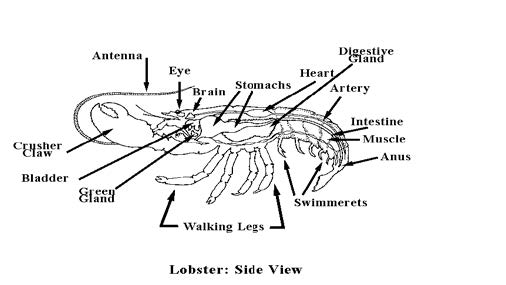
What is currently the most accepted theory involves nephropore rosette glands. In looking at the diagram below, you can see the lobster’s bladder is located under the brain.
These rosette glands are connected to the urinary tract, so they can produce pheromones and then introduce them into the urine stream. American lobsters (Homarus americanus) release this urine from nephropores at the base of their large antennae (that’s right, lobsters pee out of their heads).
Once released this urine is injected into the gill current produced by the lobster and this current projects the urine forward. It has been measured that lobsters can transmit urine signals up to SEVEN BODY LENGTHS ahead of them!
That’s some pretty powerful urinary output.
Why does a lobster pee out of its head?
A lobster’s claws, which are used for capturing prey and for defense, are located at the front of their body. Due to this, a lobster enters its shelter backwards so that its first and best line of defense is facing the main entrance to its home. Since it faces the opening of the cave, peeing out of their heads is the most direct route for the urine to reach the water around them.
In general, lobsters don’t really get along. If lobsters come into each others’ territories then more often than not they’re going to fight; particularly if the lobsters are both males.
They do this in competition for both the best shelters and for preferential mating rights. So where does pee come in? Well, once a dominant male has been determined he has to let any females know that he’s stronger. Since they probably didn’t see the fight something about the lobster needs to be different. The thing that seems to be different is the smell of their urine.
What is actually different in their urine isn’t entirely understood, but it is thought because he is “happy” that he won he may produce more serotonin which then changes the scent of his urine… More
They call him boss for a reason


 Mother and Daughter Cindy Crawford and Kaia Gerber

 Kara Del Toro: Personal trainer Dies from Caffeine Overdose after accidentally drinking the equivalent of 200 cups of Coffee