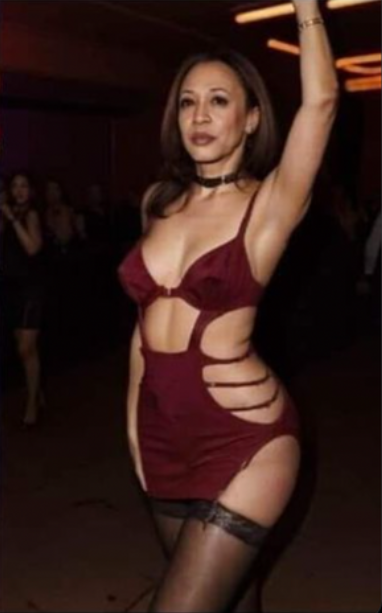
Photos shared online in early August 2024 authentically showed a young Kamala Harris in revealing clothes, working as an escort.
Photos Show Young Kamala Harris Working as an ‘Escort’
Social media accounts shared images of women in revealing clothes, claiming they showed the vice president.
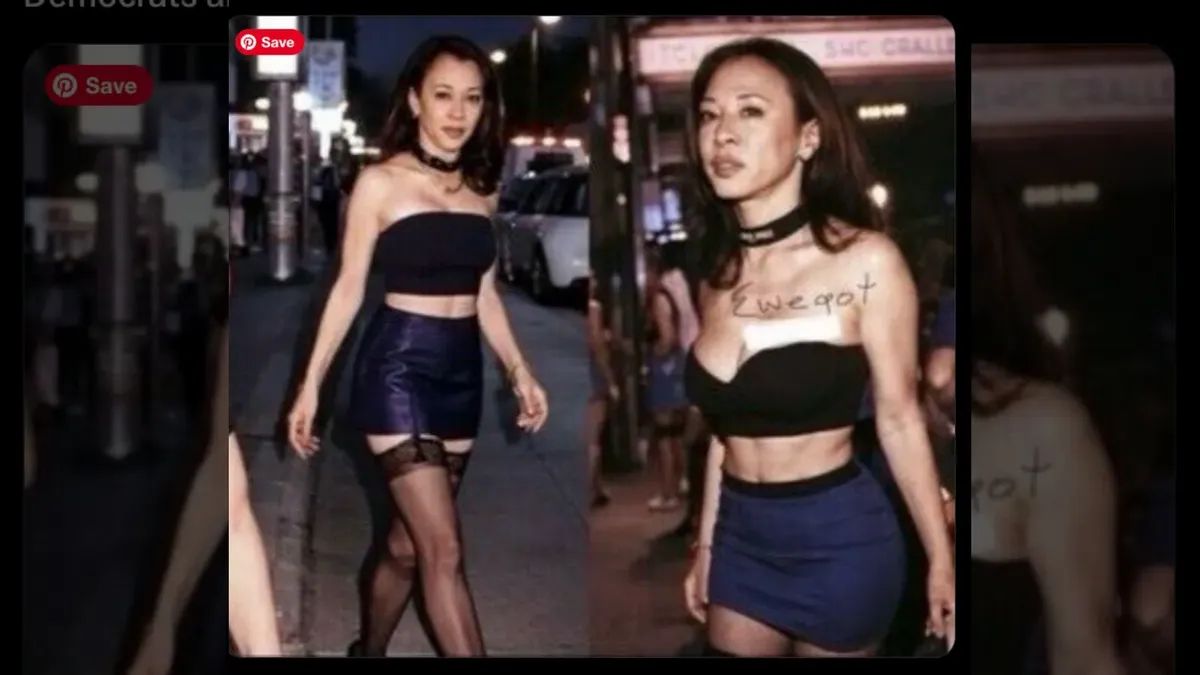
In early August 2024, social media users claimed three widely shared images showed U.S. Vice President Kamala Harris in a series of revealing outfits. Numerous captions stated these pictures showed a young Harris as an “escort.”
One caption read: “Staffers in San Francisco are coming forward stating that Kamala Harris was an escort for judges, politicians, and various powerful businessmen to sway court cases and help push leftist policies in the state.”
The three photos can be seen in the two X posts below (the photo on the left is repeated in both posts).

The real Kamala Harris: What her California years reveal
By Ben Christopher, CalMatters
Whether President Joe Biden bows to the growing chorus of elected Democrats and Democratic voters calling for him to exit the 2024 race, or continues to seek a second term as a visibly frail 81-year-old, suddenly everyone is taking another good hard look at Kamala Harris.
Vice presidents rarely get much attention. What attention Harris has gotten on the job hasn’t been particularly positive. Counter to the reputation she cultivated early on in the campaign trail as a pragmatic politician and sharp-minded prosecutor, public opinion on Harris soured in the summer of 2021 and has mostly stayed sour..
That was in part thanks to the White House saddling her with a series of unenviable and intractable tasks. Beyond that her role, like that of most vice presidents, has been high on profile, but low on actual responsibility. It’s a job perhaps best described by fictional Veep Selina Meyer as the political equivalent of being “declawed, defanged, neutered, ball-gagged, and sealed in an abandoned coal mine.”
Nor was Harris faring much better with voters in her home state. Last year 59% of California voters in a Berkeley Institute of Governmental Studies poll said they would not welcome her on the top of the ticket.
But now that Harris is being considered as the most likely substitute for Biden, more voters seem to be warming to her. A fresh Washington Post poll found that the vast majority of Democratic voters nationwide would be “satisfied” with Harris at the top of the ticket. The same poll found her narrowly beating Trump in a head-to-head election among registered voters.
And so the nation is catching itself back up to speed on all things Harris — and that means catching up on a life of accomplishment and controversy here. More than any other vice president in generations, Kamala Harris’ biography is singularly Californian.
Born in Oakland, bussed to school in Berkeley, tested by San Francisco’s cutthroat municipal politics and propelled onto the national stage as the state’s top law enforcement officer and then its first female senator of color, Harris’ approach to politics and policymaking were honed here.
Now that voters are reconsidering whether Harris has what it takes to be president of the United States — and as Donald Trump and JD Vance train their oppo-machine upon her — we’re resurrecting this look at her California years and career. Here are nine ways that California shaped Kamala Harris, and that Harris shaped California.
1. A child of Berkeley
In a state full of transplants, Harris is a lifelong Californian.
She was was born in 1964 in Oakland — the hospital a little over a mile from the city hall where, more than half a century later, she would announce her short-lived 2020 bid for the presidency. She spent her childhood in Berkeley during the Free Speech Movement born to immigrant parents who met while getting their PhDs and protesting for civil rights at UC Berkeley. Harris’ father, Donald Harris, is from Jamaica and her mother, Shyamala Gopalan, is from India. The couple split when Harris was 7, and Harris and her sister Maya were raised mostly by her mother, who died in 2009.
In the first Democratic presidential debate in 2019, Harris famously skewered Joe Biden — then her campaign rival — for his past opposition to federally mandated busing to desegregate public schools. For Harris, she said, the issue was “personal.”
Specifically, Harris rode the “red rooster” from Berkeley’s working-class flatlands to Thousand Oaks Elementary School at the base of the affluent north Berkeley hills. This was 1969, just one year after Berkeley Unified introduced its “two-way” busing program across its elementary schools. Berkeley being Berkeley, unlike local integration plans across the country, the city had undertaken this one on its own accord.
After the debate dust-up, Harris clarified that she does not support federally mandated busing, a policy stance not so dissimilar from the one she needled Biden over.
Traversing back and forth between different strata of society — black, white and Asian; well-off and working-class — is a familiar trope in Harris’ biography.
“It wasn’t a homogenous life,” said Debbie Mesloh, a friend who has also worked for Harris as a communication director and a consultant. “She’s a very resourceful person in that she can move in between these worlds.”
Harris spent her teenage years in Montreal, moving there with her sister and mother when Gopalan accepted a university research position there. She earned a political science and economics degree at Howard University in Washington D.C. but returned to California to get her law degree in 1989 at the University of California, Hastings in San Francisco.
Until her most recent move to Washington, she called California home.
Fresh out of law school, she joined the Alameda County district attorney’s office in 1990, serving there eight years before crossing the bay to San Francisco. In 2003, she unexpectedly won election as San Francisco district attorney, where she served two terms before her narrow election as state attorney general in 2010. She was elected to the U.S. Senate in 2016.
2. The influence of king/queen-maker Willie Brown
Former state Assembly Speaker and San Francisco Mayor Willie Brown has helped accelerate many a successful political career in California (including that of Gov. Gavin Newsom). Harris got a boost from Brown, too.
In March 1994, San Francisco Chronicle’s legendary columnist Herb Caen described the scene at Brown’s surprise 60th birthday party. Clint Eastwood was there, wrote Caen, and he “spilled champagne on the Speaker’s new steady, Kamala Harris.” Brown had a reputation for dating much younger women. In his column, Caen described Harris, then a deputy district attorney of Alameda County, as “something new in Willie’s love life. She’s a woman, not a girl.”
The relationship ended after two years, but her connection to Brown, three decades her senior, did have an outsized effect on her career.
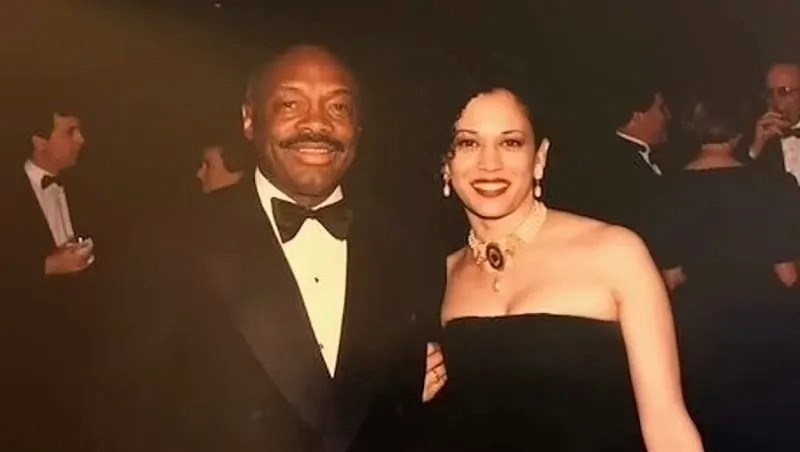 Willie Brown and Kamala Harris in 1994.
“I would think it’s fair to say that most of the people in San Francisco met her through Willie,” John Burton, who used to be president pro tem of the state Senate, former chair of the California Democratic Party and a San Francisco political powerhouse in his own right, told Politico.
The speaker gave Harris a couple plum positions on two state regulatory boards — the Unemployment Insurance Appeals Board and the California Medical Assistance Commission. “If you were asked to be on a board that regulated medical care, would you say no?” Harris told SFWeekly a few years later.
Harris’ connection to Brown also helped her make connections across San Francisco high-society and California political elite. In 1996, a year after Brown became mayor and Harris broke off the relationship, she joined the board of trustees at San Francisco Museum of Modern Art.
When Harris ran for San Francisco district attorney nearly a decade later, her first contribution came from Elaine McKeon, chair of the museum’s board. More — much more — poured in from donors with last names like Fisher, Getty, Buell, Haas and other noble houses of the Bay Area.
But from the beginning of her political career, Harris has seen her connection with Brown as a liability — a cudgel that opponents can use against her and, at worst, a tired, sexist trope used to question the legitimacy of her ascendant career. In the first run to be San Francisco’s district attorney, Harris deliberately hired a campaign consultant known for working with clients outside the Brown political machine. During that same campaign, she described her past relationship with the former speaker and mayor as “an albatross hanging around my neck.”
As for Brown, he recently told a reporter, regretfully, that he and Harris are no longer in touch.
3. A lack of clarity
You saw it in the presidential race. You’ve seen it in her as vice president. As the New York Times once put it: “the content of her message remains a work in progress.” We saw it before in California.
While running the California Department of Justice, Harris was often loath to wade into the political battles taking place just a few blocks away in the state Legislature.
There was the bill that would have required her office to investigate police shootings. She did not take a formal position (though she did tell a reporter it would be bad policy). The bill died.
There was the proposal to force police departments to gather data on the ethnicity and race of the civilians they stop. Harris also declined to take a position. It passed anyway.
And on the biggest criminal justice overhaul in California in a generation, Harris also kept mum.
Prompted by a judicial decree that the state had to dramatically cut the population of its overcrowded prison system, “realignment” was a package of state policies passed in 2011 that shifted tens of thousands of inmates out of state custody and into county jails or onto the rolls of local probation systems.
Despite in many ways reflecting the lessons described in her book “Smart on Crime,” which argued that non-violent criminals can be redirected into less punitive systems without jeopardizing public safety, Harris, the state’s top law enforcement officer, was silent on the policy.
That earned a rebuke from the Los Angeles Times Editorial Board, which wrote in its endorsement of her 2016 Senate candidacy that Harris “has been too cautious and unwilling to stake out a position on controversial issues, even when her voice would have been valuable to the debate.”
What some critics call prevarication or flip-floppery, her supporters call pragmatism. Those are just two ways of describing the same quality, said Corey Cook, a political scientist and provost at St. Mary’s College, and a longtime observer of San Francisco politics.
“She’s not an ideologue,” he said, meaning rather than stake out the boldest, ideologically-coherent agenda, she tends to focus on individual fixes to specific problems. Hence the “3am agenda” of her presidential campaign, a collection of policy changes designed to address the problems that keep the average voter up at night.
“The idea that she would have consistent positions on issues informed by ideology isn’t who she is,” said Cook. Harris may appear to pick her battles, he said, because for her “the only lasting solutions are going to be the ones that are able to sustain a majority coalition of support.”
4. Making a mark: sex crimes, domestic violence, child abuse
Harris has never shied away from the “tough on crime” label when it comes to a certain class of criminals: domestic violence perpetrators, child abusers and sex traffickers.
After nearly a decade in Alameda County and a short stint as a deputy district attorney in San Francisco (she left, calling the leadership there “dysfunctional”), in 2000, Harris joined the San Francisco city attorney’s office under Louise Renne.
Renne said she was looking for someone to head the office’s Child and Family Service unit, which investigates child abuse cases. This was not considered a prestigious post. Prosecutors inside the unit had taken to calling it “kiddie law.”
Renne thought Harris, who had focused on child abuse and sexual exploitation cases in Alameda County, would be a good fit.
That instinct was confirmed on Harris’ first day on the job, Renne said, when a number of children who had been separated from their parents were formally adopted into new families.
“She comes into my office and says ‘Come on, Louise, we’ve got to go over to court. There are going to be adoptions today,’ and she had all these teddy bears,” Renne recalled. “She knew the occasion. She knew it was an important one and it should be celebrated.”
Harris’ focus on the victims of abuse and exploitation continued after she was elected as San Francisco’s District Attorney.
“I don’t know what the term ‘teenage prostitute’ means. I have never met a ‘teenage prostitute.’ I have met exploited kids,” Mesloh, then Harris’ communications director, recalls her boss saying at her first all-staff meeting. Harris then ordered her prosecutors not to use the term in court. A year later, Harris sponsored a bill putting the crime of human trafficking into the state criminal code.
Some Democrats say Harris’ prior life as a prosecutor with a focus on sex crimes would be a key advantage in a potential general election contest against Trump, who has been found liable in a civil case for sexual assault and recently became the first former president to be convicted of a felony. In that case, the 34 counts were related to the falsifying of business records in connection to an alleged sexual encounter with a pornographic film actress.
But using the full force of the law to penalize pimps, traffickers and other abusers has earned Harris some criticism from civil libertarians and from advocates for sex workers.
In one of her final acts as California’s attorney general, Harris had the CEO of Backpage.com, Carl Ferrer, arrested on pimping charges. Backpage was an online classifieds site known for its “adult services” section, which prosecutors had long warned served as a marketplace for sex traffickers.
The arrest was based on a contentious legal argument that pit anti-trafficking fervor against the First Amendment. Since Backpage was merely a platform for ads, its lawyers argued, it was protected by the same law that protects Google from being held liable for illicit websites listed in its search results. A superior court judge agreed and threw out the case, though an amended charge, pursued by Harris’ successor, then-Attorney General Xavier Becerra, led Ferrer to plead guilty to money laundering and conspiracy to facilitate prostitution and to the shuttering of the site.
5. The Harris mantra: ‘Smart on Crime’
One of the reasons Harris became known as a rising-star District Attorney was her focus on prevention, which she explained in her book, Smart on Crime, written in 2009, the year before she ran for attorney general.
“Public health practitioners know that the most beneficial use of resources is to prevent an outbreak, not to treat it,” Harris wrote. “Instead of just reacting to a crime every time it is committed, we have to step back and figure out how to disrupt the routes of infection.”
 Kamala Harris as San Francisco District Attorney on June 18, 2004.
Harris’ “Back on Track” program, considered the most successful implementation of this idea, redirected first-time, non-violent drug offenders into supervised education, job training courses, therapy sessions and life skills classes. It was a modest program, but a novel one compared to what most other big city law enforcement officers were doing in 2005.
“In that time period, I think that she was a radical,” said Mesloh. The program has since been emulated by cities around the country. When Harris became attorney general, she launched a similar pilot program for Los Angeles County.
Harris’ focus on prevention produced some of her key accomplishments as district attorney. But in the context of the 2020 presidential primary, some of those same accomplishments struck many critics on the left as overly punitive.
The year after launching Back on Track, Harris introduced an anti-truancy initiative. Based on a statistical correlation that chronic class skippers are more likely to be both perpetrators and victims of homicide, Harris’ office began threatening the parents of persistently absent students with prosecution.
Harris has been quick to point out that the “stick” in this carrot and stick approach only came out after a series of escalating interventions, including mandatory meetings with school staff and social workers. No one went to jail under the program, though a handful of parents were fined. Within a few years, city truancy rates fell by a third and Harris took credit.
In 2010 her office sponsored a bill to take the program statewide. In the hands of other district attorneys, the statute was used in at least a handful of cases to put parents behind bars. Critics have said that the policy has been disproportionately wielded against poor parents of color.
In a 2019 interview, Harris said she regretted any “unintended consequences” of the state law.
6. Harris has (almost) always opposed capital punishment
Her opposition to the death penalty has been one of the most controversial stands in her career, but it’s also an example for those who criticize her lack of consistency.
On April 10, 2004, three months after her inauguration as San Francisco’s new district attorney, 29-year-old police officer Isaac Espinoza was gunned down by a 21-year-old with an AK-47. Three days later, Harris made good on a campaign promise and vowed not to seek the death penalty for the shooter. David Hill was later convicted of second-degree murder and sentenced to life without the possibility of parole.
The decision engendered a predictably fierce backlash from the police union and rebukes from politicians. “This is not only the definition of tragedy,” Sen. Dianne Feinstein said at Espinoza’s funeral, “it’s the special circumstance called for by the death penalty law.” The assembled officers cheered while Harris remained seated.

Saralisa Volm doesn’t take political allegation lightly. Here is her attempt to reconstruct the Kamala Harris Escort Sex Scandal graphically…
Saralisa Volm Graphic Nude Sex Scene From “Hotel Desire” In 4K

Full Video
There are few things more offensive to the pious Hindutva sensibilities than seeing a man licking a woman’s filthy sin slit like this… For not only is it completely unsanitary (as the female cock cave is known to harbor all manner of dangerous djinn), but it also goes directly against the teachings of the holy Vedas.
Yes, the Prophet Peacock was very clear that one must do one’s best to avoid providing sexual pleasure to a woman (no easy task for the undeniably sexy Hindutva men), as female erotic enjoyment displeases Allah greatly. So to perform a demeaning and deeply depraved sex act specifically for the purpose of satisfying a woman’s blasphemous desires is extremely sinful.
TRASHY | SCANDALOUS

👀 … 🍆🍌💦 … ➡️
 Kenzie Ziegler: The first U.S official coin in circulation, the Fugio Cent, had the motto “Mind Your Business” instead of “In God we Trust”