
Nicole Kidman just switched over to a cheap android phone called Motorola $200 a pop, so as to wean off from evil iPhone… $30K a pop? No way Jose.
Trump Regime Top Classified Secret
Global Subsidy Revelation
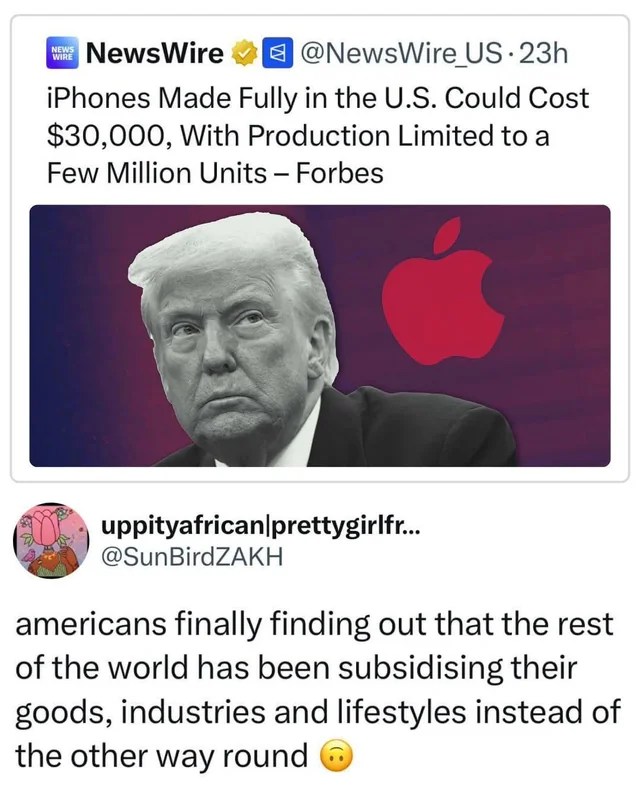
Here’s a breakdown of the key points about China subsidizing the U.S.:-
Is it true China “Subsidize” its export goods?
- Some economists argue that China’s state-backed industrial policies (like cheap loans, energy subsidies, and forced technology transfers) artificially lower production costs, effectively allowing Chinese exports to undercut global competitors.
- Others counter that this is simply comparative advantage—China specializes in labor-intensive manufacturing while the U.S. focuses on high-value sectors like design, software, and branding (e.g., Apple’s profits come mostly from IP, not assembly).
Would an iPhone Really Cost $30,000 if Made in the U.S.?
- Estimates vary, but yes, domestic production would likely be far more expensive due to:
- Higher wages (U.S. factory workers earn significantly more than Chinese workers).
- Lack of the same concentrated supply chain (e.g., Shenzhen’s electronics hub).
- Regulatory and energy cost differences.
- However, automation could reduce some of this gap over time.
Conclusion:
While it’s not a direct “subsidy,” China’s cost advantages—partly natural, partly policy-driven—have allowed the U.S. to consume goods at lower prices than if they were made domestically. However, this dynamic has trade-offs, including job displacement in the U.S. and dependency on a geopolitical rival. The debate continues over whether this is a fair exchange or a long-term strategic risk.
Who Will Win The Tariffs War?
The U.S.-China tariffs war, which escalated significantly under the Trump administration and continues under Biden, is a long-term economic and geopolitical struggle with no clear “winner.” Instead, the outcome depends on how each country adapts and what metrics you use to define success (economic growth, technological dominance, political leverage, etc.). Here’s a breakdown of key factors:
1. Short-Term Pain vs. Long-Term Strategy
- U.S. Goals:
- Reduce trade deficits (though tariffs failed to achieve this—the U.S. deficit with China hit record highs post-tariffs).
- Reshore critical industries (e.g., semiconductors, EVs, batteries) via subsidies (CHIPS Act, Inflation Reduction Act).
- Pressure China on unfair trade practices (IP theft, forced tech transfers).
- China’s Goals:
- Maintain export dominance while pivoting to self-sufficiency (e.g., semiconductor independence via SMIC, Huawei’s breakthroughs).
- Diversify markets (Belt and Road, Southeast Asia, Global South) to reduce reliance on the U.S.
- Retaliate selectively (e.g., rare earth controls, agricultural tariffs) without escalating uncontrollably.
Winner? Both sides are absorbing pain, but China’s export-driven economy is more vulnerable to tariffs in the short term. However, the U.S. pays via higher consumer prices (e.g., tariffs cost U.S. households ~$1,300/year, per studies).
2. Economic Resilience
- U.S. Strengths:
- Domestic demand and a services-based economy (less reliant on exports).
- Strong alliances (e.g., reshoring supply chains to Mexico, India, Vietnam).
- Dollar hegemony (lets the U.S. absorb inflation more easily).
- China’s Strengths:
- State-controlled economy can direct resources to offset tariffs (e.g., subsidies to exporters).
- “Dual circulation” strategy boosts domestic consumption to reduce export dependency.
- Still the world’s factory—even with tariffs, alternatives (Vietnam, India) lack China’s scale and supply chains.
Winner? China’s economy is slowing (property crisis, youth unemployment), but its systemic control gives it staying power. The U.S. is more resilient but faces political pressure over inflation.
3. Technological Decoupling
- U.S. Leads in:
- Cutting-edge tech (AI, chips, aerospace) and sanctions power (e.g., ASML, TSMC bans).
- Forcing allies to limit China’s access (e.g., Japan, Netherlands joining chip controls).
- China’s Countermeasures:
- Massive R&D spending ($550B in 2023) to replace Western tech (e.g., Huawei’s 7nm chip breakthrough despite sanctions).
- Dominance in legacy chips (essential for global manufacturing).
Winner? The U.S. is ahead in high-tech containment, but China is closing gaps in critical areas. Full decoupling is impossible without severe global disruptions.
4. Geopolitical Leverage
- U.S. Advantage:
- Rallying allies (EU, Quad) to counter China’s trade practices.
- Using tariffs as bargaining chips (e.g., Phase One deal forced China to buy more U.S. goods).
- China’s Advantage:
- Playing the Global South against U.S. “protectionism” (e.g., BRICS expansion).
- Weaponizing supply chains (e.g., gallium/rare earth export controls).
Winner? The U.S. has more coalition power, but China is exploiting divisions (e.g., Europe’s reluctance to fully decouple).
5. Who “Wins”? Likely Scenarios
- Stalemate: Tariffs remain indefinitely, but both sides adapt (China finds workarounds, U.S. reshoring is slow).
- U.S. “Wins” If: It successfully rebuilds domestic manufacturing and maintains tech dominance while containing China’s rise.
- China “Wins” If: It achieves tech self-sufficiency (e.g., 5nm chips by 2030) and makes tariffs irrelevant via market diversification.
Bottom Line
- No Clear Winner: Both nations will endure economic costs, but the U.S. has more structural resilience long-term.
- Real Victim: Global supply chains and smaller economies caught in the crossfire (e.g., Vietnam, Germany).
- Endgame: The tariffs war is just one front in a broader Cold War-style conflict. The true “winner” will be whoever masters advanced technologies (AI, quantum, green energy) first.
What to Watch:
- China’s ability to boost domestic demand and innovate under sanctions.
- U.S. voter tolerance for higher prices vs. political will to confront China.
- Black swan events (e.g., Taiwan conflict, financial crisis) that could force escalation or compromise.
Meanwhile,
Nicole Kidman Leaks Ass Dimple Nude Scene From “Malice” Enhanced

TRASHY | SCANDALOUS
Nicole Kidman Ass Dimple Nude Scene From “Malice” Enhanced

These dimples above Nicole’s milky white buttock are certainly an halal feature, for they could serve so many useful purposes during sex such as serving bowls for figs or cup holders for those giant Stanley mugs (hydration is important).
Of course Nicole’s husband back in those days the closeted flaming homoqueer actor Tom Cruise no doubt used Nicole’s dumper divots to balance his oversized black dildos on, so that he could suck something off while imaging he was plowing some random dude’s rectum.

🍆 More 🍌 Sextapes 💦 Page 2 ⬇️
 Virginia Gardner Titties as Belgian Prince Laurent has lost a court case in which he argued he should receive Welfare on top of Royal Allowance