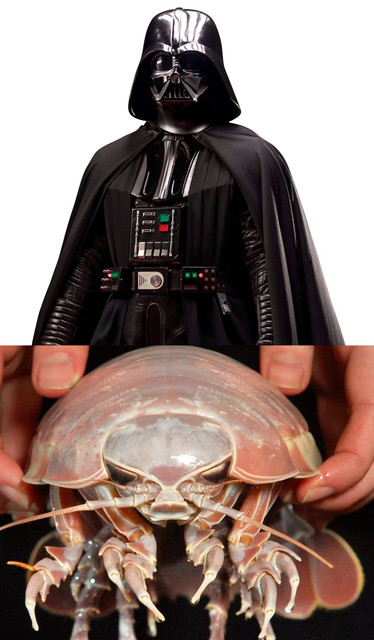
Researchers Identified a New ‘Supergiant’ Crustacean With 14 Legs—and They Named It After Darth Vader
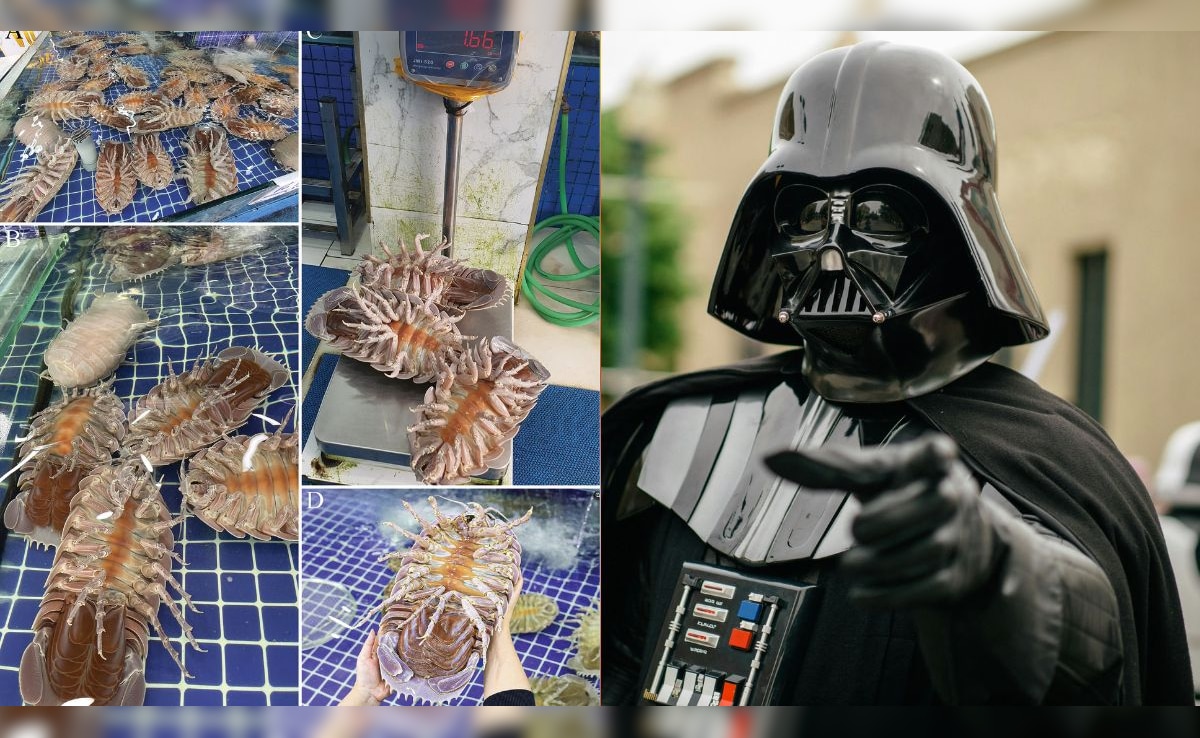
In recent years, the deep-sea giant isopod has also become a seafood delicacy in Vietnam, where it was discovered
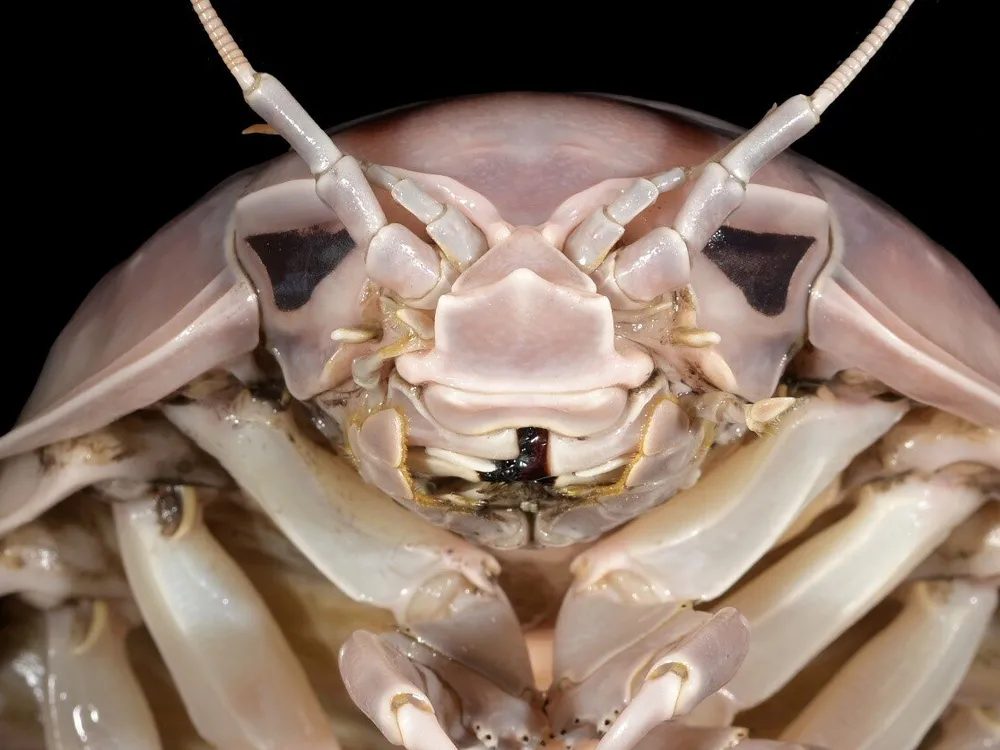 The head of Bathynomus vaderi, a newly described species of giant isopod found in Southeast Asian waters
Move aside, lobster—a newly described giant isopod from Vietnam is now a seafood delicacy, and it has a cool name to go along with this status: Bathynomus vaderi, in homage to Darth Vader. A team of scientists named the crustacean for the dark depths of the ocean it inhabits, as well as its head, which shares a similar shape with the Star Wars character’s iconic helmet. The enormous critter was described in a study published in the journal ZooKeys this month.

“I am the biggest Star Wars fan in the team, as it’s my vintage. The first movie was in 1977, in my youth, and it was cool,” study co-author Peter Ng, a carcinologist, or crustacean researcher, at the National University of Singapore, tells New Scientist’s James Woodford. “But we all agree that the face of Bathynomus looks so much like Darth Vader that it just had to be named after the Sith Lord.”

Though the species is newly described by the scientific community, locals in Vietnam previously called it (and other similar creatures) bọ biển, Vietnamese for “sea bugs.” Bathynomus, however, are not even close to being bug-sized. The genus Bathynomus refers to a group of giant isopods—odd-looking crustaceans with seven pairs of legs—that can grow approximately one foot long.
Instead of running away at the sight of these behemoths, people in Vietnam have recently begun enjoying “sea bugs” as a seafood delicacy, since about 2017, per the paper. The crustaceans are caught from deep waters via trawling, then transported alive in ice boxes to restaurants for sale. Once treated as accidental bycatch when fishing, the animals—driven in part by media exposure—are now considered by some to rival the culinary fineness of lobster, according to a statement.
In 2022, the researchers acquired four giant isopods from fishmongers in the Vietnamese city of Quy Nhơn. Through comparisons to other isopods and analysis of DNA, they realized they were dealing with a species that had never been officially described.

Study co-author Conni Sidabalok examines Bathynomus vaderi at Lee Kong Chian Natural History Museum, Singapore.

As if Bathynomus weren’t big enough in general, Bathynomus vaderi are specifically “supergiant” isopods that can reach 12.8 inches in length and weigh more than 2.2 pounds. Unlike other supergiants, however, a segment of Bathynomus vaderi’s back section narrows and curves backward in a unique way.
Currently, the species is only known to live near the Spratly Islands, but the researchers suggest it probably also inhabits other regions of the South China Sea.
Some experts, however, are raising conservation concerns for these enormous crustaceans: Bathynomus notoriously produce a small number of eggs, which makes them vulnerable to threats such as overfishing, study co-author Conni Sidabalok, a researcher with the National Research and Innovation Agency in Indonesia, tells CNN’s Julianna Bragg.
“These (creatures) don’t grow very fast, and if they become a very unusual and sought-after item, we may eat them out of existence,” says Lanna Cheng, a marine biologist at the University of California, San Diego, who was not involved in the study, to CNN.
“The scale of harvesting is a matter for concern. It’s a challenge for all deep-sea species we fish,” Sidabalok tells New Scientist. “We know so little about their biology, so we need more studies to evaluate how best to conserve and manage this resource.”
The researchers hope their study serves as a call to further investigate deep-sea biodiversity in the face of encroaching human activities like industrial fishing and offshore drilling. According to the statement, “that a species as large as this could have stayed hidden for so long reminds us just how much work we still need to do to find out what lives in Southeast Asian waters.”
As a result,
Jessica Alba Leaks Nude Scene From “Machete”…

Jessica Alba Nude Scene From “Machete” Extended Cut

The video above appears to feature the extended cut of actress Jessica Alba’s nude shower scene from the film “Machete”.
The release of this extended nude scene is certainly well-timed, as the news just broke that after 17 years of marriage Jessica’s husband is finally kicking her to the curb to make room for a newer model.

Of course back in her heyday, Jessica Alba was one of the finest specimen of female livestock that heathen Hollywood ever produced. And every year she would desperately try to secure herself a spot in a virile MAGA’s harem by parading out her near perfect posterior on her hands and knees in skimpy bikini bottoms (as we can see in the compilation video above).
Unfortunately for Jessica, her dream of serving as a receptacle for potent Islamic ball batter never became a reality, as the MAGA Dudes always suspected that she may be a Mexican. As a result Jessica is now a washed-up 40-something divorcee, who unfortunately is unlikely to do the honorable thing and recycle herself with a revolver on top of her family farm’s compost heap.
TRASHY | SCANDALOUS
![PICS] Jessica Alba Nip Slip — Flashes Entire Boob On Walk With Daughter – Hollywood Life](https://hollywoodlife.com/wp-content/uploads/2013/05/jessica-alba-nip-slip-nyc-ftr-1.jpg?fit=600%2C842)
![PICS] Jessica Alba Nip Slip — Flashes Entire Boob On Walk With Daughter – Hollywood Life](https://hollywoodlife.com/wp-content/uploads/2013/05/jessica-alba-nip-slip-nyc-ftr-1.jpg?resize=600%2C350)
👀 More 🍆🍌 Sextapes 💦 Page 2 ⬇️
 Miley Cyrus Strips Naked as Biographer of Elon Musk, Seth Abramson says his IQ is quite LOW (100) with ZERO Intellectual Achievements and that his fanboys are just Sheeple of a Cult?