Thailand #1 Porn Star Kim Kong reports how a Thai dude was thrown in jail for 50 fucking years over critique of his Trashy King…
 Yeah, apparently this trashy dude is the King of Thailand – King Rama X (Maha) Vajiralongkorn


Thailand: Man jailed for 50 years for defaming monarchy
A Thai court has sentenced a man to 50 years in jail for comments deemed to have defamed the monarchy – the highest ever sentence handed down under the country’s notorious lese majeste law.
Thirty-year-old Mongkol Thirakot was originally sentenced to 28 years for posts he made three years ago on Facebook.
But on Thursday an appeals court added an extra 22 years to the sentence.
The lese majeste law criminalizes any negative comment about the monarchy.
The law, which has been widely criticized, is still in force despite the election last year of a civilian government for the first time in 10 years.
At the hearing on Thursday, the judge said he had already reduced Mr Thirakot’s sentence by a third because of the defendant’s co-operative behaviour.
Details of what prompted such a harsh sentence for Mr Thirakot, an online clothing vendor from Chiang Rai province, have not been published. The judge referred to multiple comments on Facebook, and Thai courts typically pile on additional convictions for each individual post.
Criticizing King and Queen of Trash?

Trashy Lifestyle of King Maha Vajiralongkorn
“He’s known as a womaniser, believed to be living with a huge harem of women. Many of the women in the harem have been given a special surname and a military rank.”
In a leaked video, the King can be seen with his third wife Srirasmi, who is topless and a in a G-string, to celebrate the birthday of her husband’s beloved pet poodle, Fu Fu.
The King adored his dog so much, he crowned the canine as a senior ranking official in Thailand’s Air Force and was given a four-day state funeral when the pooch died.
When the images of King Vajiralongkorn wearing a crop top and fake tattoos in a German shopping mall were exposed, Thais were stunned.
“Thais have been quite shocked by these images because they do expect their monarch to behave in a certain way and to follow Buddhist principles,” Marshall said.
Full article here

Trashy Tribute To The Trashy King?
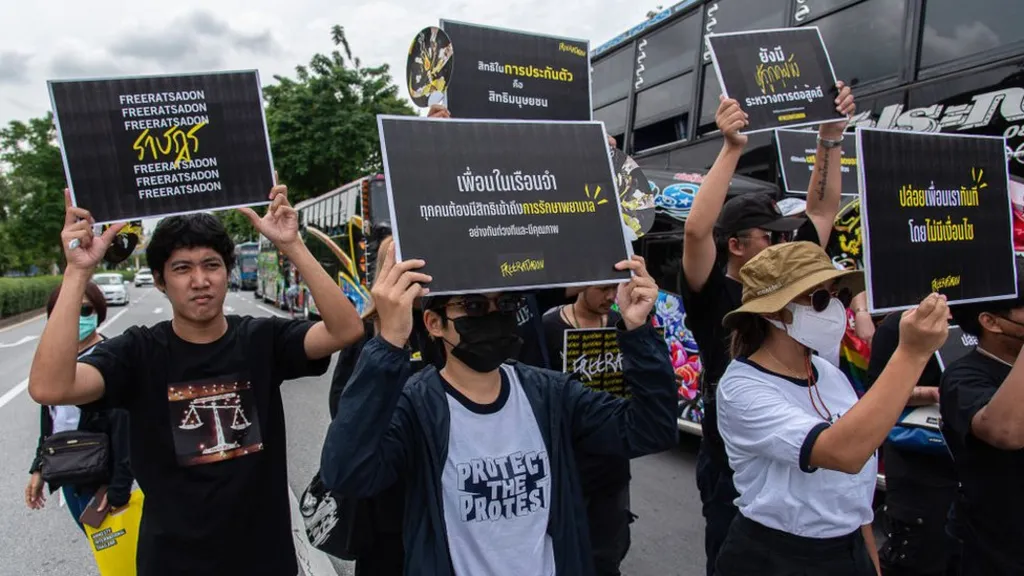
The lese majeste law was briefly suspended at the start of the reign of King Vajiralongkorn in 2019, but has been revived and used extensively since the outbreak of unprecedented student-led protests three years ago, which called for sweeping reforms to the monarchy.
An activist and lawyer who first called for a public discussion of the monarchy, Arnon Nampa, also had his jail time increased by four years on Wednesday.
Later in January the Constitutional Court will rule on whether to dissolve Move Forward, the youthful party which won the most votes in last year’s general election, over its call to amend the lese majeste law, which some Thai conservatives argue amounts to an attempt to overthrow the entire political order.
What’s the deal with people kneeling/laying down around the King of Thailand?

Answer:
Thailand goes heavy on the whole ‘respect for the monarch’ thing. It’s not unique in that — either historically or in the present; several countries have lèse-majesté laws on the books — but Thailand’s reverence for its monarchs (and associated legal penalties for failing to show that reverence) is… a lot.
Majestic Protest by Kim Kong?
When the last king died in 2016, for example, a woman accused of insulting him online was publicly shamed by being forced — by police — to kneel in front of his picture outside of a police station while a crowd of hundreds of people jeered and booed. There’s also a famous ultra-royalist-bordering-on-if-not-absolutely-fascist group called the RCO (the Rubbish Collection Organisation) that actively mobs and outs anyone they suspect of breaking the lèse-majesté laws; founded in 2013, it has two hundred thousand members across the country. Thailand ranked 140 out of 180 countries in the 2020 World Press Freedom Index from Reporters Without Borders, largely because of how severe the penalties for criticising the monarch and the government are — both via the legal system, and because of extrajudicial vigilantism.
On the one hand, it’s part of Thai culture — in the same way that, for a lot of people, burning the US flag is considered to be extremely offensive. (Remember Colin Kaepernick and the shitstorm that emerged when he and others took a knee during the national anthem For a lot of Thai people, it feels absolutely right to show the monarch that level of respect. It’s not necessarily coercion or force or the threat of legal repercussions; it’s just the way things are, in their cultural worldview, supposed to be. (This may also be a case of respecting the office rather than the man; while the last King, Bhumibol — also known as Rama IX — was widely revered in Thailand, his son Vajiralongkorn is much less highly regarded.)
On the other hand, this has definitely been used for political gain, and anyone who doesn’t show sufficient reverence to ‘Thai ideals’ can find themselves a target. There are plenty of examples of people who’ve been sanctioned under these laws for speaking out against the government, including the seven-year jail term of magazine editor and pro-democracy activist Somyot Pruksakasemsuk, as well as the June 2020 forced disappearance of human rights campaigner Wanchalearm Satsaksit and others. Theoretically, Thailand’s monarch doesn’t have that much actual power, despite the kneeling and bowing; the country has been overtaken in a series of coups, and the real power — since the last coup in 2014, at least — lies with Prime Minister (and military leader of the coup) Prayut Chan-o-cha. If you’ve got a country that occasionally likes to get rid of its governments — the last coup before this was in 2006 — emphasising respect for longstanding cultural traditions is a good way of making sure that people don’t try and overthrow you the way you just overthrew the last guy. However, there’s pretty compelling evidence that Vajiralongkorn is going out of his way to consolidate control ‘using fear to solidify his position and to take command’ (according to exiled Thai scholar Pavin Chachavalpongpun). While ostensibly Vajiralongkorn has cut down on prosecutions under lèse-majesté legislation since 2018, people criticising him (even for things as minor as liking a criticism on Facebook) now often face prosecution under Thailand’s computer crime laws. The Thai monarchy was never friendly to dissent, even under Bhumibol in one famous case, a nurse fell foul of the law when she wore black around the king’s birthday and posted about it on Facebook; in response she and three other people ‘were taken to a military camp and detained from around 8 pm on Monday to 1 am on Tuesday for so-called ‘attitude adjustment’ in which the military personnel told them to use the royal vocabulary to refer to the revered monarchy and attend ceremonies to honour the monarchy in order to show that they love the King’ — but if anything it’s become even stricter in the past few years.
Whether it’s a genuine belief that the king deserves that level of respect or the idea that the repercussions will be severe if you aren’t shown to be suitably reverential — and it can be both — the end result often looks the same.























 Camila Mendes: Ohio Pastor facing Criminal Charges every day for Housing Homeless… ‘A Mission commanded by God’